For a century, the Swedish Air Force has stood as one of Europe’s most unusual military success stories. Built by a nation committed to neutrality for more than 200 years, Flygvapnet evolved from a modest interwar aviation branch into one of the world’s most advanced and self-reliant air forces. While larger powers relied on alliances or nuclear deterrence, Sweden pursued a different path: maintain enough domestic industrial strength and military capability to discourage invasion from any side.
That strategy shaped every generation of Swedish combat aircraft, every runway hidden in forests, and every decision surrounding the country’s defense industry. From piston-engine biplanes to the Saab Gripen E, the history of the Swedish Air Force mirrors the changing security landscape of Europe itself.
Its transformation over the decades is not simply the story of aircraft. It is the story of how a small Nordic nation survived the Second World War, navigated the Cold War beside the Soviet Union, preserved technological independence, and ultimately entered NATO in 2024 after Russia’s invasion of Ukraine changed European security forever.
The Swedish Air Force did not become powerful through sheer size. It became powerful through preparation, innovation, and an obsession with survival.
The Birth of the Swedish Air Force in the Interwar Years
The roots of Swedish military aviation stretch back to the First World War, when Sweden began experimenting with aircraft as part of its army and naval forces. Although the country remained neutral during WWI, Swedish military planners recognized that aviation would transform warfare permanently.
In 1926, Sweden formally merged the aviation units of the Army and Navy into a single independent branch known as Flygvapnet, officially creating the Swedish Air Force.
Unlike Britain, France, or Germany, Sweden lacked a massive industrial base or colonial empire. This forced the country to think differently about defense. Swedish planners understood that neutrality only worked if potential aggressors believed Sweden could defend itself effectively.
During the 1930s, Europe moved steadily toward conflict while Sweden accelerated military modernization. Aircraft procurement increased, pilots received more advanced training, and domestic aviation expertise slowly expanded. Still, much of Sweden’s fleet relied on imported designs.
The outbreak of World War II would force Sweden to expand at extraordinary speed.
By the end of the war, the Swedish Air Force had become one of the largest in Europe.
World War II and Sweden’s Massive Air Force Expansion
Sweden’s neutrality during WWII often creates the impression that the country avoided military pressure. The reality was far more complicated.
Sweden sat between Nazi Germany and the Soviet Union, surrounded by occupied territories and vulnerable sea lanes. A weak defense could have invited invasion or coercion from either side. The Swedish government therefore pursued rapid military expansion, especially in the air.
The Swedish Air Force expanded to roughly 15 fighter divisions by the war’s end. For a country of Sweden’s size, this was an enormous force.
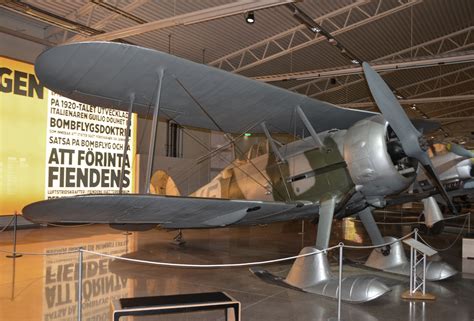
Aircraft such as the Gloster Gladiator and Hawker Hart formed important parts of the wartime fleet, but Sweden also accelerated development of its own aerospace industry. Domestic production became a national priority because wartime conditions made foreign procurement unreliable.
This period laid the foundations for Saab’s emergence as a global aerospace company.
As WWII ended, Sweden wasted little time transitioning into the jet age. The Swedish Air Force quickly acquired advanced aircraft including the P-51D Mustang, De Havilland Mosquito, and De Havilland Vampire. These aircraft bridged the gap between wartime aviation and the modern Cold War era.
The experience of surviving WWII through preparedness deeply influenced Swedish military doctrine for decades afterward.
The Cold War and Sweden’s Pursuit of Aerospace Independence
After 1945, the strategic threat shifted dramatically. Germany was defeated, but the Soviet Union now dominated the Baltic region.
Sweden suddenly found itself positioned beside one of the world’s largest military powers.
Neutrality during the Cold War required more than diplomacy. It required military credibility. Sweden concluded that dependence on foreign fighter jets created unacceptable strategic risks, especially during wartime when overseas supply chains could collapse.
This thinking pushed Sweden toward one of the most ambitious defense-industrial projects ever attempted by a small nation.
Saab became the centerpiece of Swedish military aviation.
The first major domestically developed jet fighter was the Saab J 29 Tunnan, introduced around 1950. The aircraft’s barrel-shaped fuselage looked unconventional, but it delivered impressive performance for its era and demonstrated that Sweden could design advanced jet fighters independently.
The Tunnan was followed by a succession of increasingly sophisticated aircraft:
- Saab 32 Lansen
- Saab 35 Draken
- Saab 37 Viggen
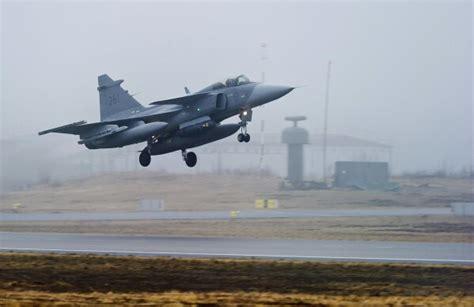
- Saab JAS 39 Gripen
Each generation reflected Sweden’s determination to remain militarily autonomous despite its relatively small population and economy.
Saab Draken and Viggen: Cold War Icons of Swedish Engineering
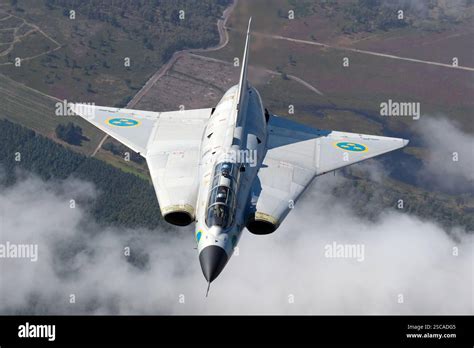
Among Sweden’s Cold War aircraft, the Saab 35 Draken became especially legendary.
Its radical double-delta wing design gave the aircraft exceptional maneuverability and high-speed performance. The Draken later became associated with the famous Cobra maneuver, a dramatic high-angle maneuver often linked to Russian fighters decades later.
The aircraft symbolized Sweden’s ability to compete technologically with much larger powers.
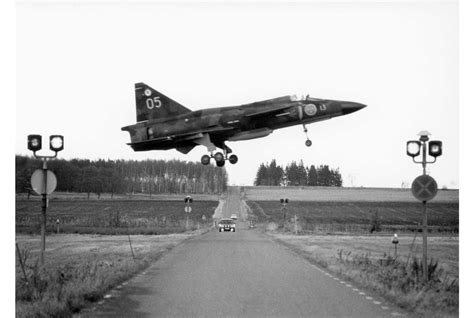
The Draken also reflected Swedish operational philosophy. Swedish fighters needed to operate from dispersed road bases, survive surprise attacks, and defend national territory under extremely difficult conditions. Survivability mattered more than expeditionary power projection.
That philosophy became even clearer with the Saab 37 Viggen.
The Viggen was optimized for rapid turnaround times and operations from short, improvised runways. Ground crews could refuel and rearm the aircraft incredibly quickly, allowing Sweden to sustain combat operations even if major air bases were destroyed.
The Viggen represented the peak of Sweden’s Cold War independence strategy.
At the same time, Sweden faced another enormous strategic dilemma: whether to develop nuclear weapons.
For years after WWII, Sweden maintained an active nuclear research program. Military planners debated whether the country should pursue atomic weapons as the ultimate deterrent against Soviet aggression.
Ultimately, Sweden chose another path.
Rather than dividing limited resources between nuclear weapons and conventional forces, Sweden invested heavily in advanced domestic defense industries instead. This decision strengthened Saab, radar development, electronic warfare systems, and military aerospace technologies.
That investment would eventually produce the Gripen.
The Gripen Program and Sweden’s Modern Fighter Strategy
By the late Cold War, designing advanced combat aircraft had become extraordinarily expensive. Even major European powers struggled to afford independent fighter programs.
Britain, Germany, Italy, and Spain combined resources to develop the Eurofighter Typhoon, while France continued funding the Dassault Rafale largely alone.
Sweden took a different route.
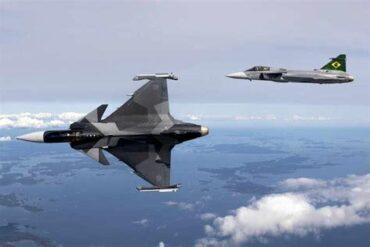
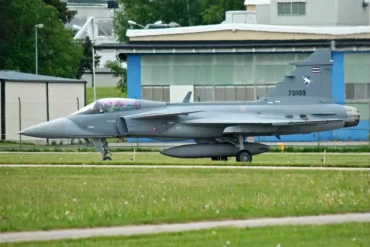
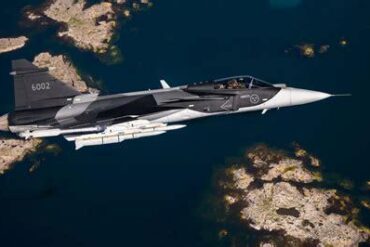
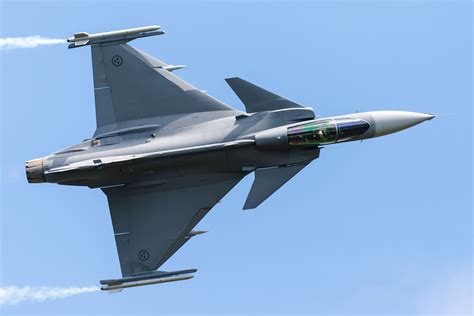
Despite being far smaller than those countries, Sweden launched development of the Saab JAS 39 Gripen during the 1980s. The aircraft was designed specifically for Sweden’s defense requirements rather than global power projection.
The Gripen emphasized:
- Low operating costs
- Dispersed operations
- Rapid maintenance
- Advanced electronic warfare
- Defensive air combat capability
The aircraft became one of the most efficient multirole fighters ever built.
However, Swedish independence had limits. Unlike the Rafale, which is almost entirely French-designed, the Gripen incorporated foreign technology including an American engine and numerous European systems.
This created what analysts often describe as a “near-sovereign” aerospace capability rather than complete independence.
Still, for a nation of roughly 10 million people, the Gripen represented a remarkable technological achievement.
The Swedish Air Force structured its doctrine around the aircraft’s strengths. Gripens could operate from hidden road bases, dispersed wartime strips, and small support facilities across the country. This concept formed part of Sweden’s broader Bas 60 and later Bas 90 defense doctrine.
The logic behind the strategy was brutally practical.
Sweden assumed that any war with the Soviet Union would involve overwhelming missile strikes and possibly nuclear attacks against traditional air bases. Dispersing aircraft across forests and highways increased the chances of survival.
This doctrine became one of the defining characteristics of the Swedish Air Force.
Sweden’s Fighter-Heavy Air Force and Baltic Defense Strategy
Unlike many modern air forces that balance fighters with strategic bombers or large transport fleets, the Swedish Air Force remained heavily concentrated on defensive fighter operations.
This reflected Sweden’s geography and security concerns.
The Baltic Sea region became the center of Swedish defense planning, particularly the strategically critical island of Gotland. Control of Gotland carries enormous military importance because it influences air and naval access throughout the Baltic.
Swedish planners long feared that Russia could target the island early in a regional conflict.
Meanwhile, Sweden’s proximity to Finland created another strategic consideration. During the Cold War, Finland was viewed as the likely frontline state in any Soviet invasion scenario. Sweden expected that its own mainland would become directly threatened only after Finnish defenses collapsed.
As a result, Sweden focused on building resilient defensive capabilities rather than offensive expeditionary forces.
Neutrality came at an enormous cost.
To remain outside military alliances while sitting near the Soviet Union, Sweden maintained an air force much larger and more advanced than most countries of comparable size.
Sweden Joins NATO and Reshapes Its Air Power Future
The Russian invasion of Ukraine fundamentally changed Swedish security policy.
After more than two centuries of neutrality, Sweden formally joined NATO in 2024. The decision marked one of the most significant strategic shifts in modern Swedish history.
In reality, Sweden had already spent decades cooperating closely with NATO forces. Swedish aircraft were NATO-compatible, joint exercises were common, and operational integration had quietly deepened long before formal membership.
Still, NATO membership changed the strategic equation completely.
The Swedish Air Force was no longer designed solely for independent national survival. It now became part of a collective defense structure spanning Europe and North America.
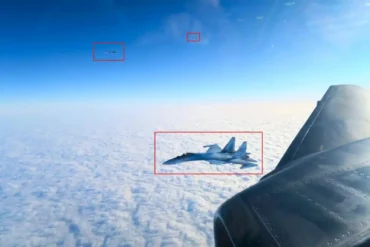
Swedish fighters now participate in NATO air policing missions across the Baltic region, helping secure alliance airspace against potential Russian threats.
At the same time, important questions remain about Sweden’s long-term aerospace independence.
Should Sweden continue trying to develop fighter aircraft independently inside NATO? Or should it eventually join multinational projects like Britain, Italy, and Japan’s GCAP/Tempest program?
Those questions remain unresolved.
The Future of the Swedish Air Force Beyond Its First Century
The Swedish Air Force is entering its second century during one of the most turbulent security periods Europe has seen since the Cold War.
Sweden is currently acquiring 60 Saab Gripen E fighters, with deliveries extending toward 2030. These aircraft will operate alongside older Gripen C/D models, creating a modernized but cost-conscious force structure.
Sweden is also strengthening its broader military aviation capabilities through several major programs.
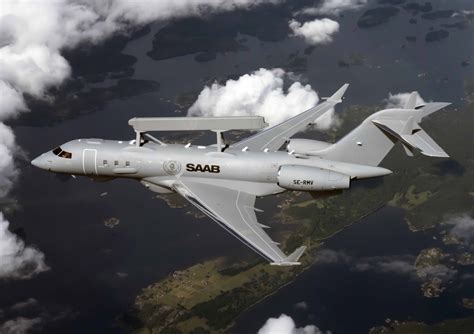
The country is accelerating procurement of the Saab GlobalEye AEW&C aircraft, expanding airborne surveillance and command capabilities. Meanwhile, Swedish transport aviation is evolving through acquisition of the Embraer C-390 Millennium tactical airlifter.
Helicopter modernization is also underway, with Sweden moving away from the troubled NH90 fleet in favor of additional UH-60 Black Hawks.
Perhaps most importantly, Sweden is beginning to expand into military space operations. A dedicated space division was established in 2023, followed by the launch of Sweden’s first military satellite in 2024.
The next great challenge may be sixth-generation combat aviation.
Saab continues exploring future fighter concepts, but the financial and technological demands of sixth-generation aircraft are immense. Even major powers increasingly rely on multinational cooperation to afford such programs.
For Sweden, partnerships may become unavoidable.
Yet the core identity of the Swedish Air Force remains unchanged after 100 years. It is still built around survivability, technological innovation, dispersed operations, and national resilience.
From fragile biplanes in the 1920s to advanced Gripens patrolling NATO skies, the Swedish Air Force has evolved continuously while staying remarkably faithful to its original mission: ensuring that Sweden can never be easily intimidated, invaded, or controlled by a larger power.