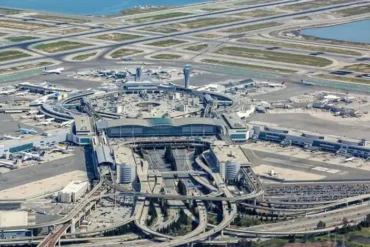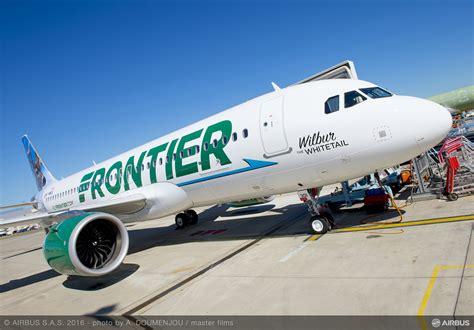
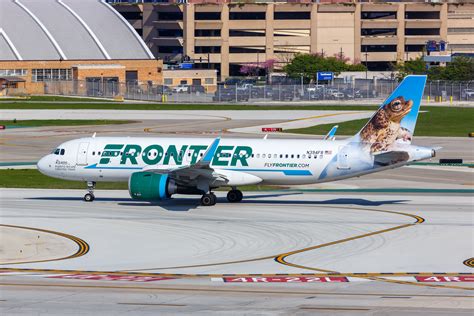
When Frontier Airlines flight 9369 lifted off from San Francisco International Airport (SFO) on April 16, 2025, no passengers were aboard. It wasn’t a regular commercial service; instead, it was a ferry flight—a special flight operated without passengers, usually for repositioning or maintenance. The aircraft in question, an Airbus A320neo registered as N369FR, was bound for Denver International Airport (DEN), a journey that typically takes under two and a half hours. But this time, the flight lasted five hours and 34 minutes, covering an unusually winding and low-altitude route that has aviation enthusiasts buzzing.
An Unprecedented Flight Path for a Familiar Route
The flight path of N369FR was anything but ordinary. FlightAware data reveals that after departing San Francisco, the aircraft flew south along California’s Pacific coastline, skirting near the Mexican border, then turned eastward, tracing a trajectory roughly parallel to the U.S.-Mexico border. Once in Texas airspace, the aircraft veered northward, eventually arriving in Denver.
This elongated route makes little sense for a direct point-to-point flight between San Francisco and Denver. But more puzzling is the altitude profile: the entire flight remained at or below 10,000 feet, far lower than the typical cruising altitudes of 35,000 to 41,000 feet for commercial jets.
Such an unusual routing and altitude constraint almost certainly points to a technical irregularity, and the most likely culprit is a cabin pressurization issue.
The Case for a Pressurization Malfunction
Commercial aircraft cabins are designed to simulate lower altitudes by maintaining internal pressure, usually the equivalent of 6,000 to 8,000 feet, even when flying above 30,000 feet. If this pressurization system fails, the consequences are serious. According to FAA regulations, under Part 91 (which governs ferry flights), crew members must wear supplemental oxygen if cabin pressure exceeds 12,500 feet for more than 30 minutes, and oxygen is mandatory at all times above 14,000 feet.
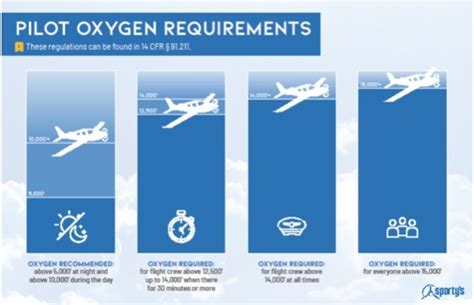
Rather than risk exhausting the crew’s oxygen supply or exposing them to hypoxia, the aircraft was most likely limited to flying below 10,000 feet—a safe threshold where supplemental oxygen is not required for crew. That altitude restriction, combined with the necessity to avoid the towering Rocky Mountains, helps explain why the aircraft diverted so far south before turning toward Denver.
Flying this low over such a long distance severely reduced the aircraft’s fuel efficiency and speed. The A320neo is optimized for high-altitude cruise, where thinner air reduces drag. At low altitudes, drag increases, and so does fuel consumption, causing not only the time but also operational costs to rise significantly.
Denver: More Than Just the Destination
Why was Denver chosen as the endpoint for this flight, despite the added burden of flying slowly and circuitously? The answer lies in Denver’s role as Frontier Airlines’ largest operational hub—and, crucially, its primary maintenance base.
Frontier operates five maintenance bases across the United States—in Denver, Dallas, Las Vegas, Phoenix, and Orlando. Among these, Denver International Airport is the most comprehensive, fully equipped to perform complex inspections and repairs, including pressurization system diagnostics. Given this infrastructure, rerouting N369FR to Denver for detailed examination and potential repairs would have been both logistically and economically sound.
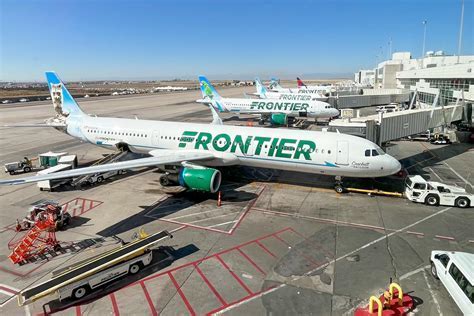
According to flight data, N369FR had flown in from Atlanta (ATL) the evening before and remained parked overnight at San Francisco. It wasn’t involved in any scheduled services on April 16 until it made its way to Denver. Interestingly, the aircraft resumed regular commercial operations the following day, suggesting that the issue—while potentially critical—was likely resolved swiftly upon arrival.
Landing Gear Complications: A Less Likely But Notable Possibility
Some aviation observers floated an alternate theory: that the aircraft may have suffered a landing gear malfunction. When landing gear cannot be retracted after takeoff, aircraft must fly at reduced speed to prevent structural damage. In such cases, airlines might also elect to fly at lower altitudes, although this is not an FAA requirement—it’s driven by engineering limitations and safety practices.
There’s precedent for this behavior. In recent years, Lufthansa and Global Airways ferried Airbus A380s with gear extended, flying low and slow to ensure safety while transitioning aircraft from storage locations to active bases. But in those cases, the gear extension was intentional, a result of no available jacks to test gear retraction. Moreover, neither of those flights stayed consistently below 10,000 feet, as N369FR did.
Given the prolonged low altitude, the routing around high terrain, and the safety implications, it’s far more likely that pressurization, not gear, was the root cause.
Understanding the A320neo Pressurization System
The Airbus A320neo pressurization system is a critical component of the aircraft’s environmental control system (ECS). It functions via bleed air, sourced from the engines and processed through air conditioning packs to regulate temperature and pressure. Two Cabin Pressure Controllers (CPCs) manage the process—one active, the other in standby.
Key system functions include:
- Monitoring cabin altitude and differential pressure
- Controlling the outflow valve to maintain desired pressure
- Ensuring smooth transitions during climb and descent
A failure in either the CPC, the bleed air source, or the outflow valve actuator can render the system inoperative. When that happens, aircraft must default to unpressurized operation, subject to altitude limits.
In-flight pressurization anomalies are rare, but they are serious enough to immediately remove the aircraft from service for diagnostic testing, especially if an error occurs outside the standard redundancy built into the system.
Altitude vs. Human Safety: The Risks of Hypoxia
Flying at high altitudes without proper pressurization risks a condition called hypoxia, where the body is deprived of adequate oxygen. Symptoms include euphoria, confusion, dizziness, cyanosis (blue fingers), and eventually unconsciousness. The danger is that hypoxia often develops without the affected person realizing it.
FAA guidance defines “Time of Useful Consciousness” (TUC) at various altitudes:
- 25,000 ft: 3–5 minutes
- 30,000 ft: 1–2 minutes
- 35,000 ft: 30–60 seconds
- 40,000 ft: 15–20 seconds
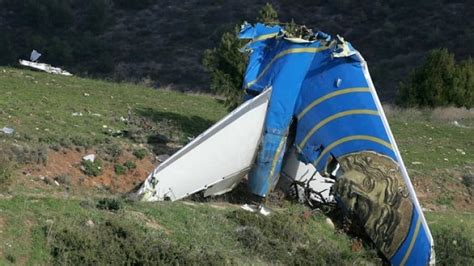
A chilling reminder of this risk was the Helios Airways Flight 522 tragedy, where an unnoticed pressurization fault led to everyone on board passing out, resulting in the aircraft crashing near Athens after exhausting its fuel under autopilot control.
For pilots, donning oxygen masks quickly is a last line of defense. But for a ferry flight, which could last hours, it’s simply impractical to rely on mask-based oxygen systems, especially when better solutions—like flying below 10,000 feet—exist.
Why the Southern Route? Navigating Terrain Safely
The decision to route the aircraft south before turning toward Denver wasn’t arbitrary. Between San Francisco and Denver lies the Rocky Mountains, the longest mountain range in North America, with some peaks exceeding 14,000 feet, especially around Colorado.
To maintain a safe altitude buffer below 10,000 feet without risking a collision with terrain, N369FR’s flight planners charted a course around the southern extent of the range, over Arizona and New Mexico, where elevation drops significantly. This minimized the risk of Controlled Flight Into Terrain (CFIT), a leading cause of aviation accidents when aircraft fly into high terrain due to visibility or planning failures.
By using this terrain-aware routing strategy, Frontier ensured that even in a non-pressurized state, the flight could be completed safely without breaching FAA altitude limitations or compromising crew health.
Conclusion: A Logistical Puzzle with a Logical Answer
Though we await official confirmation from Frontier Airlines, the evidence strongly supports a pressurization-related ferry flight. From the unusual routing and extended duration to the altitude restrictions and choice of destination, everything aligns with industry protocol for handling unpressurized flight scenarios.
This flight reminds us just how complex and safety-focused modern aviation is. Even for a non-revenue, empty aircraft, protocols demand meticulous planning, risk management, and prioritization of crew safety over speed or fuel efficiency. That’s why aviation remains the safest mode of transportation in the world.
Today, N369FR is once again flying commercial passengers, its brief but remarkable detour a hidden chapter in the never-ending story of operational safety and technical resilience in aviation.