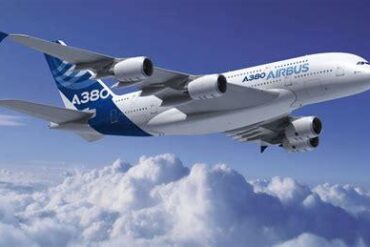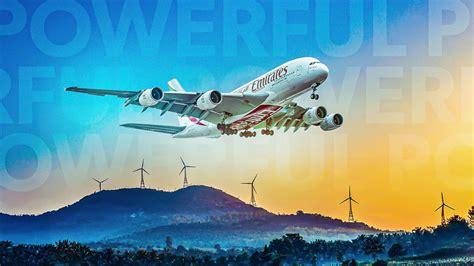
The Airbus A380 was never designed to be subtle. From its first sketches, it was conceived as a flying declaration of what modern aerospace engineering could achieve when limits were treated as suggestions rather than barriers. Every dimension of the aircraft, from its towering vertical tail to its cavernous double-deck fuselage, exists because Airbus wanted to answer a single question with absolute confidence: how powerful can a commercial airliner be?
The answer, even today, is that nothing else comes close. The A380 remains the most powerful passenger aircraft ever to enter commercial service, a machine whose raw thrust, structural strength, and payload capability place it in a category of its own. While aviation has shifted toward leaner twin-engine efficiency, the A380 stands as a reminder that brute force, when applied intelligently, can achieve astonishing results.
Its power is not just about engine numbers or size. It is about how all its systems—engines, wings, landing gear, fuel, and structure—work together to lift more mass, farther, and more smoothly than any other airliner ever built.
A Superjumbo Built Around Sheer Force
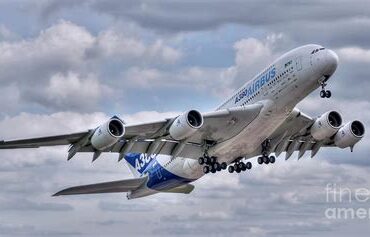
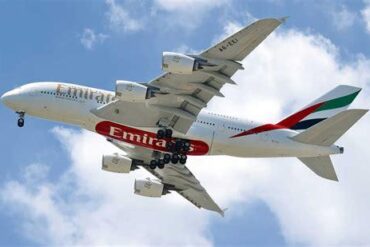
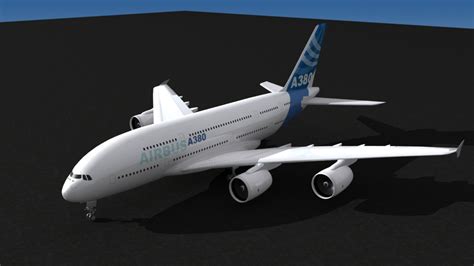
The Airbus A380 stretches 72.72 meters in length, with a wingspan of nearly 80 meters, making it impossible to mistake for anything else on the ramp. But its physical scale is only the surface expression of a deeper truth: this aircraft was engineered to move extraordinary weight with absolute authority.
At full load, the A380 can weigh up to 575,000 kilograms, a number that borders on the absurd for something that lifts itself into the air using nothing but airflow and combustion. To make that possible, Airbus had to rethink almost every assumption about wing strength, structural loads, and propulsion.
The aircraft belongs to a fading class of quadjet airliners, alongside legends like the Boeing 747 and Airbus A340. While modern twins have proven that two engines are sufficient for long-haul efficiency, four engines gave the A380 designers freedom. They could distribute thrust, reduce individual engine stress, and achieve levels of takeoff performance that remain unmatched.
By design, the A380 was never about compromise. It was about dominance.
Four Engines, One Unmatched Thrust Profile
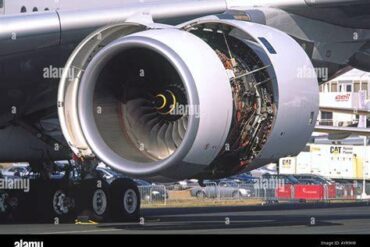
At the heart of the A380’s power are its four engines, each capable of producing roughly 75,000 pounds of thrust. Airlines could choose between two options: the Rolls-Royce Trent 900 or the Engine Alliance GP7200, both engineering masterpieces in their own right.
When all four engines are operating at maximum output, the A380 can generate nearly 300,000 pounds of total thrust. To put that into perspective, this is roughly equivalent to the combined thrust of six Boeing 737-class aircraft. That kind of force is not merely impressive—it is transformational.
This thrust allows the A380 to accelerate smoothly despite its enormous mass, lifting off with a confidence that surprises even seasoned pilots. During takeoff, the wings experience such immense aerodynamic loading that they can flex upward by as much as four meters, a dramatic visual demonstration of physics at work rather than structural weakness.
Airbus once described the takeoff thrust across the wing as equivalent to the combined horsepower of around 2,500 family cars. It is a poetic way of saying that the A380 does not so much take off as it overpowers gravity.
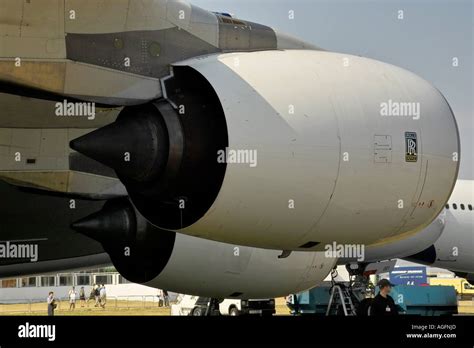
Rolls-Royce Trent 900 vs Engine Alliance GP7200
The decision to offer two engine options was strategic. Airbus wanted to broaden the A380’s appeal and avoid dependence on a single manufacturer. The result was a fascinating rivalry between two very different philosophies of engine design.
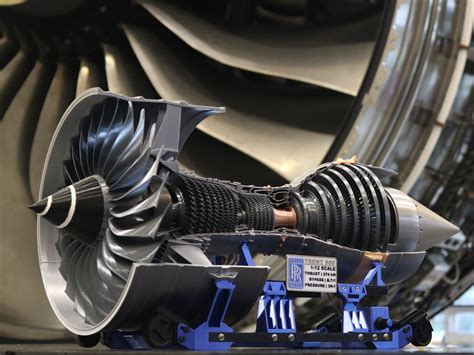
The Rolls-Royce Trent 900 was derived from the proven Trent family, building on decades of operational experience. It emphasized reliability, maintenance efficiency, and long-term durability. Many airlines valued this continuity, especially those already operating other Trent-powered aircraft.
The Engine Alliance GP7200, developed by a joint venture between GE Aerospace and Pratt & Whitney, focused on high performance in hot and demanding environments. This made it especially attractive to Middle Eastern carriers operating long-haul routes in extreme temperatures.
Although early orders leaned toward Rolls-Royce, the balance shifted when Emirates, the A380’s largest customer, selected the GP7200 for the majority of its fleet. Today, thanks largely to Emirates’ continued commitment, the GP7200 powers most of the A380s still flying.
Both engines share one crucial trait: exceptionally high bypass ratios, approaching 9:1, which allows them to move enormous volumes of air efficiently. Each engine’s fan, measuring 116 inches in diameter, pulls in roughly 1.25 tonnes of air every second during flight.
Power That Is Surprisingly Quiet
One of the A380’s most counterintuitive qualities is how quiet it is. Despite its size and power, it is widely regarded as one of the quietest widebody aircraft ever built.
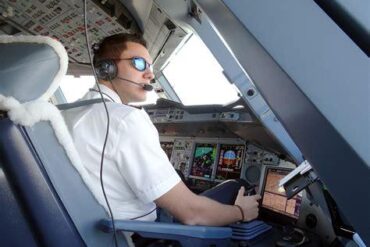
This is not an accident. The high bypass engines, carefully shaped nacelles, and advanced acoustic treatments dramatically reduce noise output. On the ground, the A380 has a smaller noise footprint than many smaller jets. In the air, its cabin noise levels are so low that pilots resting in onboard crew bunks have reportedly found the silence almost unsettling.
The aircraft proved that power and refinement are not opposites. With the right engineering, brute force can be civilized.
Unmatched Takeoff and Landing Weight
Power matters most when it meets resistance, and nowhere is that more evident than during takeoff and landing. The A380’s certified Maximum Takeoff Weight of 575,000 kg remains unmatched in commercial aviation.
This figure is nearly 30% higher than the Boeing 747-8, its closest rival. Even the upcoming Boeing 777-9, the longest passenger aircraft ever built, will operate at only about 60% of the A380’s MTOW.
Airbus did not settle for a single weight limit. Over the aircraft’s development, the company increased the A380’s MTOW twice, enabling longer ranges and heavier payloads. This flexibility allowed airlines to adapt the aircraft to evolving route demands without sacrificing performance.
On landing, the A380 is just as imposing. Its Maximum Landing Weight of 394,000 kg is the highest of any commercial jet. To manage this, the aircraft rides on 22 wheels, distributing loads across the runway with remarkable efficiency and stability.
Payload Capacity That Redefined Long-Haul Travel
The A380 was built to carry a lot of everything: people, luggage, cargo, and fuel. In typical airline configurations, it carries over 500 passengers, but it is certified for up to 853 in high-density layouts.
Beneath the passenger decks lies a vast cargo hold capable of moving significant freight alongside full passenger loads. This dual capability made the A380 especially attractive on routes where demand for both seats and cargo was consistently high.
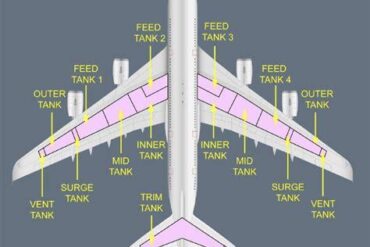
With its immense fuel capacity and structural strength, the A380 can operate some of the longest commercial routes on Earth. Flights like Dubai to Auckland, spanning over 14,000 kilometers, are well within its capabilities, even with heavy payloads.
These missions highlight the aircraft’s unique strength: the ability to move enormous mass across intercontinental distances without compromise.

Efficiency at Scale
Critics often focus on the A380’s size, but size was precisely what allowed it to achieve impressive efficiency per seat. When fully loaded, the aircraft delivered up to 33% lower fuel burn per passenger compared to earlier-generation widebodies.
Noise emissions were reduced by roughly 50%, and advanced aerodynamics helped minimize drag despite the aircraft’s massive frontal area. On dense hub-and-spoke routes, the A380 could move more passengers using fewer total flights, easing congestion at major airports.
The problem was not performance. The problem was timing. As airlines shifted toward point-to-point networks using smaller, highly efficient twinjets like the A350 and Boeing 787, the market for ultra-large aircraft shrank.
The A380 did exactly what it was designed to do. The world simply changed around it.
Why the Airbus A380 Still Matters
Even as production has ended, the Airbus A380 remains a benchmark. No other commercial aircraft has combined raw power, structural strength, passenger capacity, and long-range capability in quite the same way.
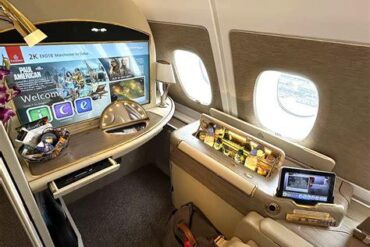
For engineers, it stands as a case study in what happens when ambition is matched with technical rigor. For passengers, it remains one of the most comfortable ways to cross an ocean. For aviation history, it is a reminder that progress is not always linear.
The A380 was never just an airplane. It was a statement: that human ingenuity, when given enough room to breathe, can still produce machines that feel almost mythic.
In an era increasingly defined by optimization and restraint, the Airbus A380 endures as the most powerful expression of commercial aviation ever to leave the ground.